
read the article

Introduction: Why 20L Chemical Packaging Demands a Different Engineering Approach
When a chemical packaging factory approached TAIXIANG MACHINE, the requirement was deceptively simple: produce 20L PET containers for industrial chemical concentrates. The reality, however, involved far more than scaling up a standard beverage bottle blower. Chemical packaging introduces variables that water and juice lines never encounter—aggressive surfactant resistance, extended shelf-life stress cracking, thicker wall distribution for UN-certified transport, and the need for handle integration that survives drop testing.
This case study examines how TAIXIANG engineered a 20L large bottle blowing solution that addressed these constraints without compromising cycle stability or energy efficiency. For procurement engineers and production managers evaluating large-format PET blow molding equipment, the technical decisions documented here offer a practical reference framework.
The Application Challenge: Beyond Beverage-Grade Blowing
The client’s product portfolio included alkaline cleaners, solvents, and agricultural adjuvants—formulations known to accelerate environmental stress cracking (ESC) in standard PET grades. Unlike carbonated soft drink bottles, which rely on internal pressure for structural rigidity, 20L chemical containers must maintain dimensional integrity under static load, stacking pressure, and chemical exposure over months of warehousing.
Three technical requirements emerged during the initial consultation:
1. Wall Thickness Uniformity Across Complex Geometry
A 20L chemical bottle is rarely a simple cylinder. The client’s design featured a recessed label panel, an integrated handle, and a reinforced base. Blowing such a shape from a single preform demands precise axial and hoop stretch ratios. Uneven stretching creates thin spots that become failure initiation sites under chemical attack.
2. Preform Thermal Profile Control for Thick Sections
20L preforms are substantially heavier than their beverage counterparts, with wall sections that can exceed 8mm in the neck and handle transition zones. Infrared heating must penetrate deeper without overheating the surface—a common cause of surface crystallization and subsequent stress cracking.
3. Mold Venting and Cooling for Deep-Draw Features
The handle cavity and recessed panel create air traps during high-pressure blowing. Inadequate venting produces incomplete forming, visible surface defects, and inconsistent material distribution. Simultaneously, the thicker sections require extended cooling to prevent post-mold shrinkage and warpage that would misalign the bottle on filling lines.
TAIXIANG’s Technical Solution: TX-20 Platform Configuration
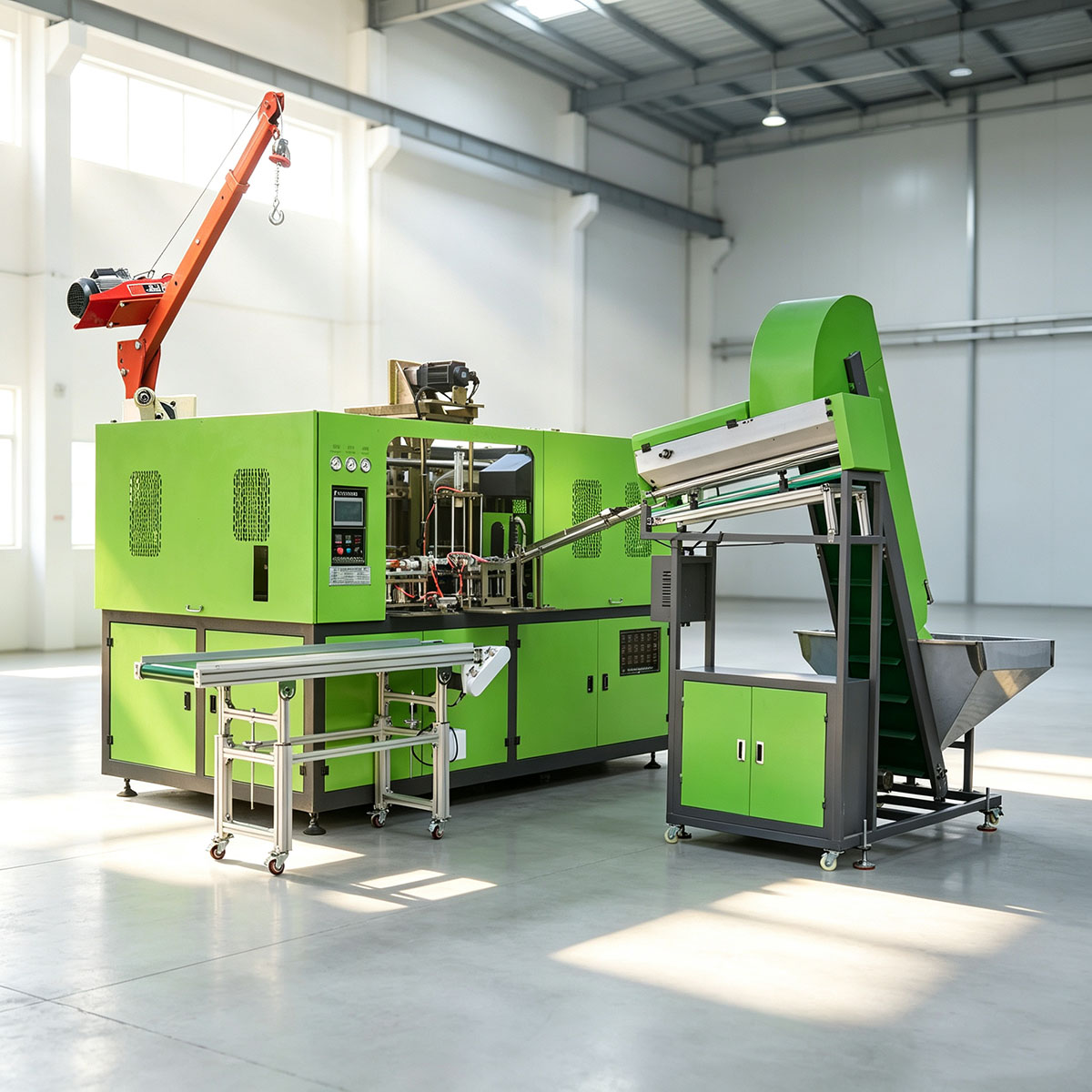
TAIXIANG proposed the TX-20-1 single-cavity configuration from its large bottle platform, a machine family purpose-built for 5L to 20L containers with industrial-grade servo drive and extended heating tunnel architecture.
Servo-Driven Stretch Rod for Repeatable Wall Distribution
The TX-20-1 employs a servo-actuated stretching rod rather than a pneumatic cylinder. For 20L chemical bottles, this distinction matters at the millimeter level. The servo rod allows programmable stretch velocity and position, enabling the operator to slow axial stretching through the handle region—where material must flow into the grip cavity without thinning the adjacent body wall—while accelerating through the cylindrical body.
Pneumatic systems, by contrast, deliver a force curve that varies with air pressure fluctuations and seal wear. Over a production run of 50,000 bottles, that variability translates into measurable wall thickness scatter and higher scrap rates. The servo platform maintains positional repeatability within ±0.1mm, which the client validated through sectioned bottle audits at 2,000-bottle intervals.
Extended Heating Tunnel with Zone-Isolated IR Control
The TX-20-1 features an extended heating tunnel with independent temperature control zones. For the client’s preform—weighing approximately 280g with a 48mm neck finish—the heating profile was calibrated as follows:
| Preform Zone | Target Surface Temp | Function |
|---|---|---|
| Neck finish | 95–105°C (cooled) | Prevent deformation under blow clamp |
| Upper body | 115–120°C | Initiate axial stretch |
| Handle transition | 125–130°C | Maximize material flow into grip |
| Lower body & base | 110–115°C | Controlled cooling before blow |
The zone-isolated control prevented the handle transition region from overheating while ensuring the base—the thickest section—received sufficient thermal energy for complete stretch. Without this granularity, the client’s initial trials on a generic large-bottle machine produced bottles that passed visual inspection but failed 48-hour chemical immersion tests due to micro-cracks at the handle-body junction.
Mold Design Collaboration: Venting and Cooling Strategy
TAIXIANG’s mold engineering team worked directly from the client’s 3D bottle files to optimize the cavity for the TX-20 platform. Two design interventions proved critical:
Vent placement: Additional 0.03mm vent slots were positioned along the handle perimeter and the lower edge of the recessed panel—locations where the expanding preform trapped air during the final 0.3 seconds of blowing. Without these vents, the client observed incomplete fill and surface whitening at the handle root.
Conformal cooling: The handle cavity received a dedicated cooling circuit with baffled flow, reducing local mold surface temperature by 12°C compared to the body cavity. This prevented the thick handle section from remaining semi-molten at ejection, which had caused post-mold shrinkage that rendered roughly 8% of early samples out-of-round at the base.
Production Validation: Measured Outcomes
After commissioning and a two-week process optimization period, the TX-20-1 line achieved the following results under continuous three-shift operation:
| Metric | Measured Value | Industry Benchmark (20L Chemical) |
|---|---|---|
| Output | 320–350 BPH | 250–400 BPH typical |
| Scrap rate (post-stabilization) | 1.8% | 3–5% common for complex 20L molds |
| Wall thickness variation (body) | ±0.12mm | ±0.20mm acceptable |
| Energy consumption (blowing + heating) | 32 kW | 40–45 kW for comparable pneumatic systems |
| Mold change time (20L to 10L) | 14 minutes | 30–45 minutes typical |
The energy figure warrants emphasis. The TX-20 platform’s servo drive eliminates the continuous pneumatic bleed that characterizes conventional blow molding clamps. For a factory running 6,000 hours annually, the 8–13 kW reduction translates to a meaningful operating cost advantage—particularly in regions where industrial electricity tariffs exceed $0.12/kWh.
Key Engineering Takeaways for Chemical Packaging Applications
1. Servo stretching is not a luxury for 20L chemical bottles—it is a baseline requirement.
The handle integration and wall thickness tolerances demanded by chemical packaging leave no margin for the force variability inherent in pneumatic systems.
2. Preform heating is a three-dimensional problem.
Zone count and independent control matter more than total heater wattage. The ability to cool the neck finish while over-heating the handle transition is what separates a viable process from a marginal one.
3. Mold venting is often underestimated in large-format blowing.
For bottles with handles, recessed panels, or deep labels, vent design deserves the same engineering attention as cooling layout. The client’s 8% early scrap rate was traced entirely to vent insufficiency, not machine performance.
4. Energy efficiency compounds in single-cavity large-bottle production.
Because cycle times for 20L bottles are inherently longer than beverage applications (typically 65–80 seconds versus 8–12 seconds), every kilowatt of parasitic load—pneumatic bleed, inefficient heating, excessive cooling—is multiplied across a smaller output base. Servo-driven platforms mitigate this structural disadvantage.
Conclusion: TAIXIANG’s Role as a PET Blowing Solution Partner
This project illustrates why TAIXIANG MACHINE positions itself not as a catalog equipment vendor but as a PET blow molding solution specialist. The TX-20-1 hardware provided the foundation—servo precision, extended heating, industrial clamping—but the outcome depended on application-specific engineering: mold venting analysis, thermal profile development, and validation against the client’s actual chemical formulations.
For chemical packaging manufacturers evaluating 20L PET blow molding equipment, the case demonstrates that machine specifications alone are insufficient selection criteria. The supplier’s capacity to engage with preform design, mold engineering, and process validation determines whether a 20L line achieves 2% scrap or 8% scrap—a difference that, at 300 BPH, represents hundreds of thousands of bottles annually.
TAIXIANG MACHINE supplies PET blowing machines from 3L to 20L across semi-automatic and fully automatic platforms, with application engineering support for chemical, edible oil, wide-mouth, and custom container formats. For technical consultation on 20L large bottle projects, contact our engineering team with your bottle specifications and production requirements.