
read the article

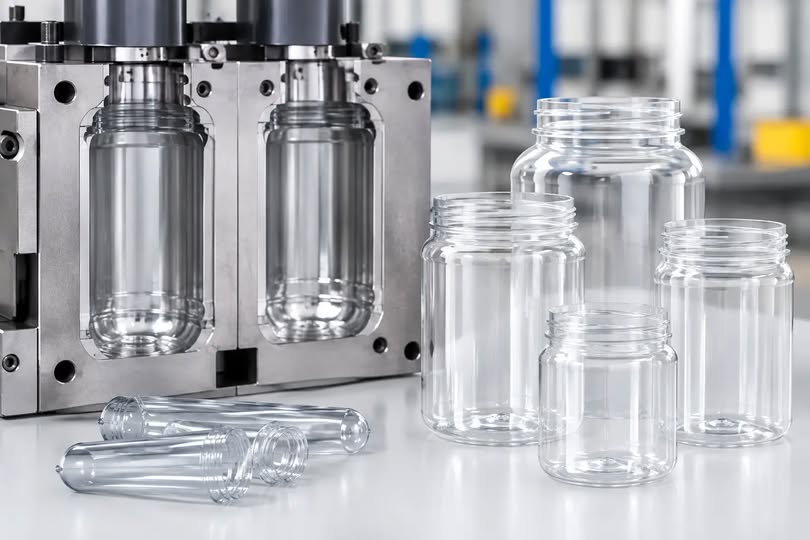
Air Compressor and Chiller Selection for Blow Molding Production Lines
By TAIXIANG MACHINE | PET Blow Molding Solution Expert (https://www.tztaixiang.com/)
Executive Summary: Why Auxiliaries Make or Break Blow Molding Output
In a PET stretch blow molding (SBM) line, the blow molding machine and molds get the spotlight, but the air compressor and industrial chiller determine whether your line runs at rated bottles per hour (BPH) or suffers chronic pressure drops, overheating, and reject spikes. Undersized compressed air starves pre-blow and high-pressure blowing, while unstable cooling water lengthens mold cycle times and warps bottle necks or bases. As a professional PET blow molding machine and custom mold manufacturer (TAIXIANG MACHINE), we engineer complete turnkey blowing lines—including matched air compressors, chillers, air dryers, and storage tanks—so every subsystem works in balance.
1. Air Compressor Selection: Pressure Stages, Airflow, and Air Quality
PET blow molding lines typically rely on clean, dry compressed air across two functional tiers: low/medium-pressure air (around 0.7–1.0 MPa / 7–10 bar) for pneumatic actuation, clamping, and controls, and high-pressure blowing air (often 2.5–4.0 MPa / 25–40 bar depending on bottle size, wall thickness, and cavity count) to stretch and form heated preforms cleanly inside the mold.
- Sizing Airflow (CFM / m³/min) with Headroom: Calculate total air demand from cavity count, cycle speed (BPH), bottle volume, and single- or multi-stage air recovery, then add a safety margin (typically 15%–25%) to prevent pressure sag during peak demand.
- Moisture and Oil Control: Water droplets or oil carryover in high-pressure air cause internal bottle haze, contamination, valve wear, and mold corrosion. Pair compressors with refrigerated/desiccant air dryers, precision filtration, and properly sized air receiver tanks to buffer peak blow pulses.
- Energy Efficiency: High-pressure air generation is one of the largest electricity consumers in a blow molding plant. Matching compressor output to real demand—and using air-saving or air-recovery blow molding designs where applicable—directly lowers kWh per thousand bottles.
2. Industrial Chiller Selection: Cooling Capacity, Temperature Stability, and Flow Rate
An industrial water chiller removes heat from PET molds (and often hydraulic/electrical or auxiliary components) so newly blown bottles solidify rapidly without shrinkage, distortion, or sticking in the cavity.
- Calculating Cooling Load (kW / kcal/h / Tons): Base chiller sizing on total heat rejected per hour—driven by preform throughput (kg/h of PET), mold cavity count, cycle time, and ambient plant temperature—rather than guessing from machine size alone.
- Water Temperature Control: Most PET blow molding molds run chilled water in a controlled range (commonly around 8°C–15°C depending on bottle geometry, wall thickness, and humidity). Too cold in humid climates can cause condensation ("sweating") on molds and rails; too warm slows cooling and increases cycle time or ovality.
- Flow Rate, Pressure, and Loop Cleanliness: Sufficient pump flow and head pressure ensure turbulent heat transfer inside mold cooling channels. Use clean treated water and periodic strainer/heat-exchanger maintenance so scale and debris do not insulate cooling passages.
3. Matching Compressors and Chillers to Bottle Type and Line Speed
Different containers place very different demands on compressed air and cooling capacity:
- Small-to-Medium Beverage & Daily-Use Bottles: High BPH speeds require fast air recovery in receiver tanks and steady mold cooling to keep cycle times short and neck finishes round.
- Large Containers, Wide-Mouth Jars, and Edible Oil Bottles: Thicker walls and larger surface areas require substantial high-pressure air volume and sustained heat extraction to prevent base warp, sink marks, or uneven clarity.
- Semi-Automatic vs. Automatic Lines: Semi-automatic lines have lower peak BPH than high-cavity automatic rotary or linear lines, but still fail if air pressure drops mid-cycle or mold water warms up during long runs.
4. Why Integrated Turnkey Sourcing Beats Piecemeal Buying
When plants buy a blow molding machine, molds, air compressor, and chiller from separate vendors without coordinated engineering, commissioning often stalls due to mismatched pressure ratings, undersized piping, or unclear responsibility between suppliers.
- One-Stop Engineering by TAIXIANG MACHINE: As a specialized PET blow molding manufacturer, TAIXIANG MACHINE provides semi-automatic and automatic PET blowing machines, custom high-precision molds, and matched auxiliary equipment (air compressors, chillers, dryers, and tanks) tailored to your target bottles and output.
- Faster Commissioning & Lower TCO: Pre-matched parameters mean cleaner startup, stable bottle quality from shift one, and streamlined technical support from a single accountable team.
Selection Checklist for Blow Molding Line Buyers
| Subsystem | Key Parameters to Specify | Main Risk If Undersized |
|---|---|---|
| Air Compressor & Dryer | Working pressure (MPa/bar), airflow (m³/min or CFM), dew point, receiver tank size | Incomplete blowing, sharp corners/ribs, valve/mold wear |
| Industrial Chiller | Cooling capacity (kW / kcal/h), target supply temp (°C), flow rate & pump head | Longer cycle times, bottle deformation, mold condensation |
| Line Integration | Bottle volume, preform weight, target BPH, ambient plant temperature | Bottlenecks, higher power cost per bottle, commissioning delays |