read the article

Introduction: Why Cavity Count Defines Your PET Bottle Production Economics
When evaluating a PET stretch blow molding machine, the number of cavities is arguably the single most consequential specification you will decide—far more important than brand name or minor feature differences. The cavity count directly determines your maximum theoretical output, your energy consumption per bottle, your factory floor space requirements, and ultimately your total cost of ownership over the machine's 15–20 year service life [citation:9].
At TAIXIANG MACHINE, we have manufactured and deployed thousands of PET blow molding systems across more than 80 countries. This analysis draws on our engineering expertise and real-world customer data to provide an honest, technical comparison between the two most common entry-to-mid-range configurations: two-cavity and four-cavity machines.
Whether you are launching a new bottled water line, expanding a contract packaging operation, or evaluating whether to upgrade from a semi-automatic setup, this guide will give you the engineering and financial framework to make the right decision.
Technical Specifications: A Direct Comparison
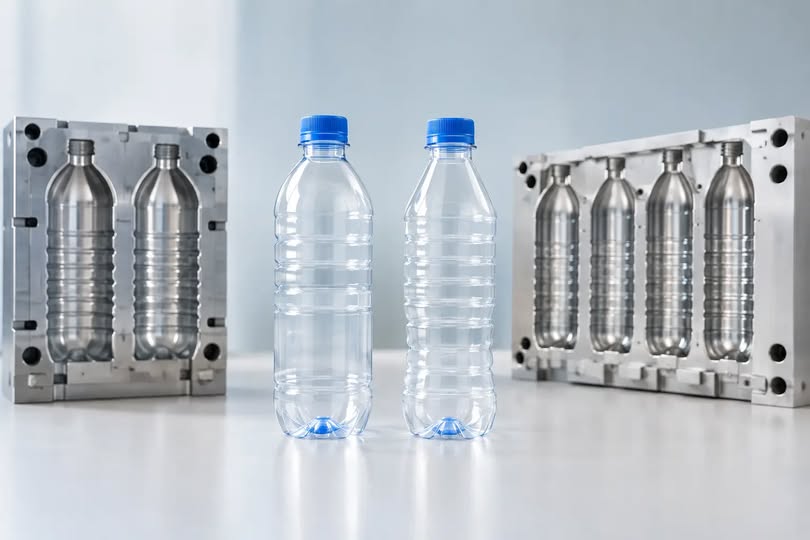
Before analyzing pros and cons, let us establish the fundamental technical differences. The table below compares representative specifications from TAIXIANG's own automatic PET blow molding machine lineup, which ranges from 2 to 9 cavities [citation:2].
| Parameter | TAIXIANG 2-Cavity (e.g., TX-106-2) | TAIXIANG 4-Cavity (e.g., TX-106-4) |
|---|---|---|
| Theoretical Output (BPH) | 1,500 – 2,500 | 3,500 – 5,500 |
| Maximum Bottle Volume | 2,200 – 3,000 ml | 2,000 ml |
| Maximum Heating Power | 44 – 48 kW | 64 – 80 kW |
| Approximate Floor Space | 15 – 20 m² | 20 – 25 m² |
| Typical Investment Level | Baseline (1.0×) | 1.6 – 1.8× |
| Operator Requirement | 1 operator | 1 operator (standard) |
Data based on TAIXIANG automatic PET blow molding machine specifications and industry benchmarks [citation:2][citation:4].
Two-Cavity Blow Molding Machine: Pros and Cons
Advantages of a 2-Cavity Configuration
1. Lowest Barrier to Entry
The two-cavity machine represents the most capital-efficient entry point into automatic PET blow molding. For startups, regional water bottlers, or manufacturers testing a new product line, the initial investment is significantly lower—typically 40–45% less than a comparable four-cavity system [citation:4]. This reduced financial exposure allows you to establish production, validate market demand, and generate cash flow before committing to higher-capacity equipment.
2. Compact Footprint for Constrained Facilities
A two-cavity machine including service access areas occupies roughly 15–20 square meters [citation:4]. For factories where floor space is at a premium—or for operations co-located with filling lines—this compact footprint simplifies layout planning and reduces the need for facility expansion. TAIXIANG's entry-level models are specifically engineered for this segment, with dimensions starting at 4.3 m × 3.2 m for the complete system [citation:1].
3. Suitability for Larger Bottle Formats
Two-cavity machines often handle larger container volumes more efficiently than higher-cavity configurations. For bottles in the 1L to 3L range—including edible oil containers and large-format water bottles—the two-cavity setup provides adequate output without the clamping force limitations or cycle-time penalties that can affect multi-cavity systems running large molds [citation:4]. TAIXIANG's TX-130-2 and TX-138-2 models, for example, support bottles up to 2,800 ml and 3,000 ml respectively [citation:2].
4. Simpler Maintenance and Faster Troubleshooting
With fewer cavities, the heating oven is shorter, the pneumatic circuit is less complex, and the control logic is more straightforward. For factories with limited technical staff or in regions where specialized service support is not immediately available, this simplicity translates to higher uptime and lower maintenance anxiety.
Limitations of the 2-Cavity Approach
1. Lower Absolute Output
At 1,500–2,500 BPH, a two-cavity machine will struggle to support high-volume contracts or multi-shift operations with aggressive delivery schedules. If your business plan projects steady growth, you may find yourself running overtime or planning a second machine within 12–18 months [citation:10].
2. Higher Per-Bottle Energy Cost
While the two-cavity machine consumes less total power (approximately 48 kW heating vs. 64 kW for four cavities), the energy consumed per bottle is higher. The fixed overhead of heating, clamping, and control systems is spread across fewer units of production, reducing overall energy efficiency [citation:4].
3. Limited Scalability Without Equipment Duplication
Scaling a two-cavity operation typically requires purchasing additional machines rather than upgrading the existing unit. While this provides redundancy (a valid operational strategy), it also duplicates infrastructure costs—air compressors, chillers, and floor space—rather than leveraging economies of scale [citation:4].
Four-Cavity Blow Molding Machine: Pros and Cons
Advantages of a 4-Cavity Configuration
1. The "Sweet Spot" for Mid-Volume Production
The four-cavity machine delivers approximately 3,500–5,500 BPH, which aligns well with the production requirements of growing beverage brands, regional contract packers, and bottled water companies serving medium-density markets [citation:2]. This output level is sufficient to support a dedicated filling line running one to two shifts without excessive idle capacity or chronic overtime.
2. Superior Per-Bottle Economics
Though the four-cavity machine costs more upfront, the per-bottle manufacturing cost drops significantly. The installed power increases by only about 30–40% compared to a two-cavity unit, while output roughly doubles [citation:1][citation:4]. Labor efficiency also improves: a single operator can manage a four-cavity system just as easily as a two-cavity one, effectively halving the labor cost per thousand bottles [citation:4]. For most business cases, this improved operational leverage justifies the higher initial investment within 15–20 months [citation:10].
3. Better Energy Efficiency per Unit of Output
TAIXIANG's four-cavity automatic machines incorporate advanced IR heating with multi-zone control and optional air recovery systems. While the absolute heating power is higher (64–80 kW), the machine produces more than twice the bottles per hour. The result is a measurable reduction in kilowatt-hours per 1,000 bottles—a critical metric as energy costs continue to rise globally [citation:2].
4. Optimal for Standard Water and CSD Bottles (500ml–750ml)
The four-cavity configuration is particularly well-suited to the most common bottle sizes in the beverage industry. With cycle times optimized for 500ml–750ml containers, the four-cavity machine achieves its rated output without pushing the mechanical limits of the clamping unit or heating oven [citation:4][citation:10].
Limitations of the 4-Cavity Approach
1. Higher Capital Requirement
The initial investment for a four-cavity machine is typically 1.6–1.8 times that of a two-cavity system [citation:10]. For a startup with limited capital or uncertain demand forecasts, this represents meaningful financial risk. If the projected volume fails to materialize, the fixed cost burden can strain cash flow.
2. Larger Space and Utility Requirements
Beyond the machine footprint (20–25 m²), the four-cavity system demands higher-capacity air compressors, chillers, and electrical infrastructure. Factories planning a four-cavity installation must verify that their existing utilities can support the increased load—or budget for upgrades [citation:4].
3. Reduced Flexibility for Very Large Bottles
While four-cavity machines excel at standard beverage sizes, they are less adaptable to large-format containers (3L and above). The clamping force and mold size constraints of a four-cavity platform make it impractical for production runs that shift frequently between small and large bottles [citation:4].
Total Cost of Ownership: A Three-Year Analysis Framework
Cavity count decisions should never be made on purchase price alone. A proper evaluation requires modeling the total cost of ownership (TCO) over at least three years. The key variables are:
- Capital Expenditure: Machine price, molds, auxiliary equipment (compressor, chiller).
- Energy Cost: kWh per 1,000 bottles × annual production volume × local electricity rate.
- Labor Cost: Operator wages × shifts × years. Higher-cavity machines reduce labor per bottle.
- Maintenance and Spare Parts: Generally proportional to machine complexity, but four-cavity machines have more wear points (more cavities, larger oven).
- Opportunity Cost of Downtime: A four-cavity machine losing an hour of production represents twice the lost revenue of a two-cavity machine [citation:1].
For most manufacturers with confirmed demand exceeding 3,000 BPH, the four-cavity TCO is lower by year two or three. For demand below 2,000 BPH, the two-cavity machine remains the financially rational choice.
Decision Framework: Which Configuration Fits Your Business?
| Your Situation | Recommended Configuration | Rationale |
|---|---|---|
| Startup / pilot production (< 2,000 BPH needed) | 2-Cavity | Minimize capital risk; validate market before scaling. |
| Regional water brand with stable demand (3,000–5,000 BPH) | 4-Cavity | Optimal balance of investment and per-bottle economics. |
| Large-format bottles (1L–3L) as primary product | 2-Cavity | Better mold compatibility and cycle efficiency for large containers. |
| Contract packer with multiple SKUs (500ml–750ml) | 4-Cavity | Higher output with quick mold-change capability. |
| Limited floor space or constrained utilities | 2-Cavity | Compact footprint and lower utility demand. |
| Projected growth to >5,000 BPH within 18 months | 4-Cavity | Avoids costly equipment duplication and reconfiguration. |
TAIXIANG MACHINE: Your Engineering Partner for Cavity Selection
At TAIXIANG MACHINE, we do not believe in one-size-fits-all recommendations. Our automatic PET blow molding machine range spans 2 to 9 cavities, with outputs from 1,500 BPH to over 12,000 BPH [citation:2]. This breadth allows us to match the machine to your actual business case—not to push you toward a higher-margin configuration.
Our engineering team provides:
- Volume forecasting support: We help you model seasonal demand, growth projections, and shift patterns to determine the true required BPH.
- Utility assessment: Before shipment, we review your compressed air, chiller, and electrical capacity to prevent commissioning surprises.
- Mold strategy consultation: Cavity count and mold design are interdependent. We advise on the optimal number of mold sets for your SKU portfolio.
- Lifetime technical support: Every TAIXIANG machine is backed by remote diagnostics and on-site service availability in over 80 countries [citation:2].
Whether you need the cost-effective TX-106-2 for a new water plant or the high-output TX-106-4 for a growing beverage brand, our team will help you specify the right machine the first time.
Frequently Asked Questions
Can I upgrade a 2-cavity machine to 4 cavities later?
In most cases, no. The heating oven, clamping unit, and pneumatic system of a two-cavity machine are dimensioned for two cavities. Upgrading requires replacing major assemblies, which is often more expensive than purchasing the correct machine initially. We strongly recommend forecasting 3–5 years of demand before ordering.
What is the typical lead time for a TAIXIANG 4-cavity machine?
Standard automatic PET blow molding machines typically ship within 30–45 days of order confirmation, depending on configuration and mold requirements. Custom specifications may require additional time.
Does cavity count affect bottle quality?
Modern multi-cavity machines maintain consistent quality through balanced heating zones, synchronized pneumatics, and independent cavity controls. TAIXIANG's four-cavity systems are engineered to deliver uniform wall thickness and burst strength across all cavities [citation:4].
What is the minimum order quantity for TAIXIANG blow molding machines?
We supply single machines and complete production lines. There is no minimum order quantity for machine purchases.