
read the article

Solving PET Preform Deformity and Overheating Issues: A Quick Maintenance Guide by TAIXIANG
Published by TAIXIANG MACHINE Engineering Department | Solution Experts in High-Efficiency PET Stretch Blow Molding Systems
Executive Summary & Technical Overview
In high-speed Polyethylene Terephthalate (PET) bottle production, achieving structural integrity, optical clarity, and uniform wall thickness requires precision temperature control and synchronized mechanical stretching. Two of the most common operational bottlenecks faced by blow molding facilities globally are PET preform deformity (such as neck finish distortion or body warping) and preform overheating (leading to haziness, crystallization, or wall thinning).
As a leading manufacturer of high-efficiency PET stretch blow molding machines, TAIXIANG MACHINE (Taizhou Huangyan Taixiang Plastic Machinery Co., Ltd.) has developed this comprehensive maintenance guide. Designed for engineers, machine operators, and plant managers, this guide details practical troubleshooting protocols, root-cause analyses, and preventative maintenance strategies to maintain continuous, high-yield production.
TAIXIANG Expert Insight: PET is a semi-crystalline polymer. Its glass transition temperature ($T_g$) lies between 70°C and 80°C, while its optimal blowing window is strictly maintained between 95°C and 115°C. Operating outside this narrow thermal window directly leads to thermal degradation or mechanical stress deformation.
1. Root Causes & Technical Analysis of Preform Deformity
Preform deformity occurs when the preform loses its structural geometry before or during the stretch blow molding process. This issue usually manifests in three distinct ways:
- Neck Finish Ovality / Thread Distortion: The neck region becomes soft and deforms during heating or transfer, leading to capping failures.
- Body Bending / Curvature: Asymmetrical heating causes differential thermal expansion across the preform body.
- Base / Bottom Sagging: Over-softening of the preform base leads to stretching misalignment and base blowout.
Primary Causes & Corrective Actions
| Defect Manifestation | Root Cause Analysis | TAIXIANG Recommended Solution |
|---|---|---|
| Neck Thread Deformity | Insufficient neck protection cooling water flow; infrared oven lamp proximity too close to neck shield. | Verify neck cooling channel temperature (keep below 20°C). Adjust top reflector plates to shield neck threads completely. |
| Unilateral Body Bending | Uneven IR lamp tube output; damaged quartz heating tubes; asymmetrical air ventilation in oven zones. | Check individual IR tube resistance. Re-balance cooling fan airflow across all heating zones. Replace faulty lamp tubes. |
| Preform Pin-Hole / Base Sag | Excessive heat focus on zone 1 (bottom zone); excessive mandrel rotation friction causing tilt. | Lower bottom lamp intensity by 5–10%. Inspect preform holder mandrels and replace worn bearings. |
2. Diagnosing and Resolving Preform Overheating Issues
Overheating occurs when the thermal energy absorbed by the preform exceeds the structural equilibrium required for biaxial orientation. Overheated PET material loses its molecular orientation capacity, resulting in severe quality failures:
- Pearlescence & Haze: Thermal crystallization occurs when preform temperature exceeds 120°C, causing micro-voids and white haze.
- Sectional Thinning: Overheated regions stretch prematurely, leaving other bottle sections thin and structurally weak.
- Mold Sticking: Excessively hot preforms stick to the blowing mold cavity, causing scuffs and ejection delays.
Step-by-Step Thermal Calibration Protocol
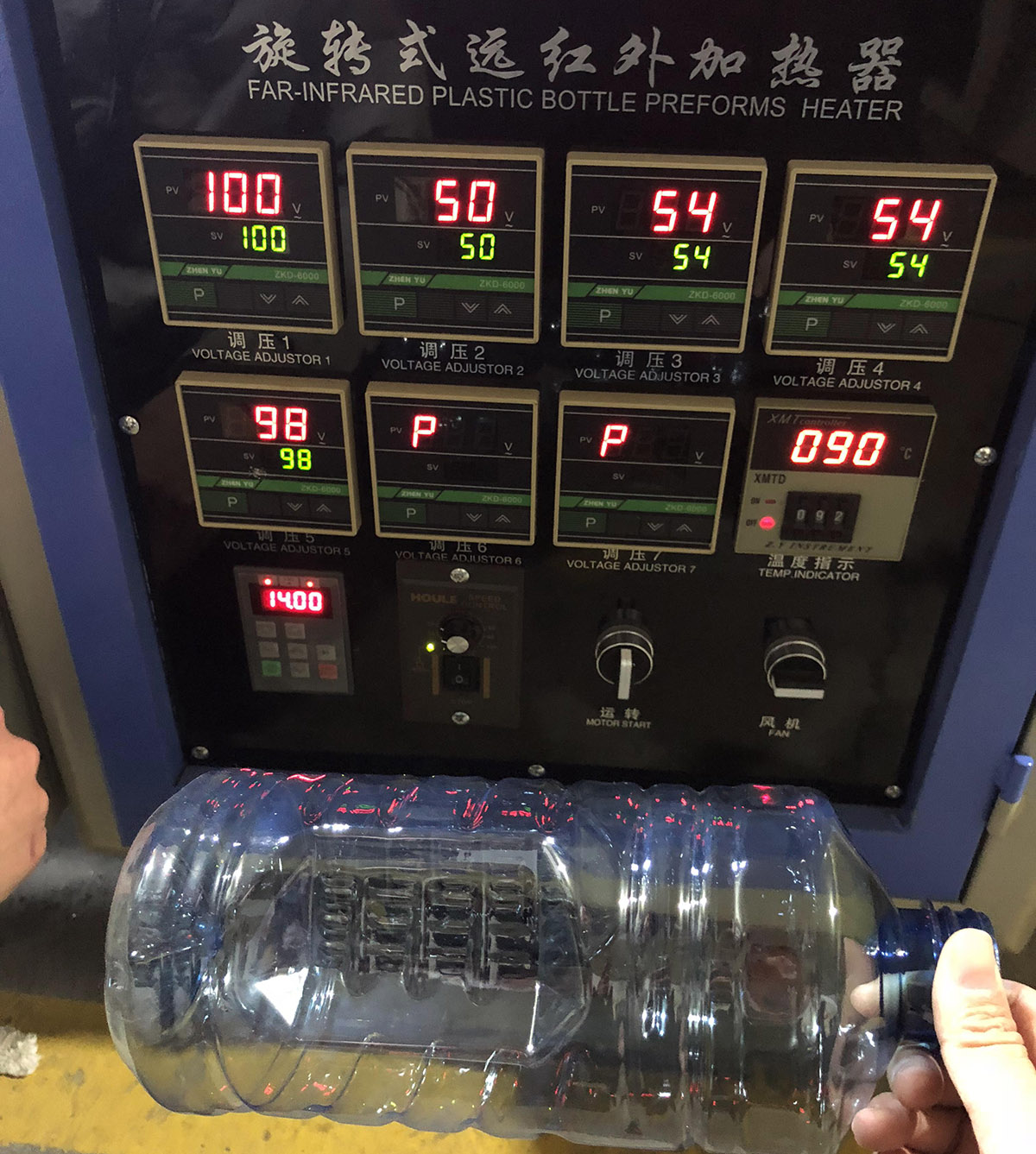
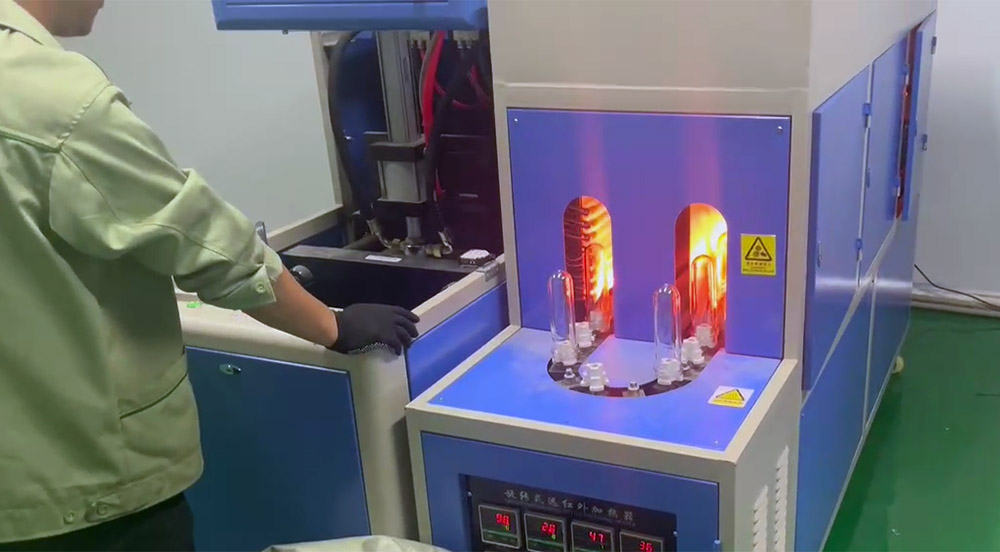
- Calibrate IR Lamp Zone Profiles: Avoid running all oven zones at 100% capacity. Optimize lamp zone distribution (e.g., higher heat at shoulder and body, controlled lower heat at base and neck).
- Inspect Oven Ventilation & Exhaust System: Ensure exhaust blowers actively remove ambient heat from the heating oven. Accumulated heat raises the ambient oven temperature, overheating preform surfaces without penetrating the core.
- Check Preform Rotation Consistency: Verify that preforms rotate 360 degrees smoothly as they pass through the IR lamps. Inconsistent rotation causes local hot spots.
- Optimize Chilled Water Circulation: Maintain neck protection water circulation at 15–18°C with stable pressure (3–4 bar).
3. TAIXIANG Preventive Maintenance Checklist for Blow Molding Efficiency
Preventative maintenance is essential for eliminating unplanned downtime and ensuring consistent bottle quality across millions of production cycles. TAIXIANG MACHINE recommends integrating the following maintenance schedule into your standard operating procedures (SOP):
| Frequency | Maintenance Focus Area | Action Required |
|---|---|---|
| Daily (Per Shift) | Oven Cleanliness & Infrared Reflectors | Wipe clean stainless steel reflective plates to ensure maximum IR reflectivity. Remove dust from quartz tubes. |
| Weekly | Chiller & Water Lines | Inspect flow meters for neck cooling shields and mold cooling circuits. Check for scale buildup or pressure drops. |
| Monthly | Mandrels, Grippers & Chains | Check preform transfer grippers and rotation chain tension. Lubricate high-temperature bearings with food-grade grease. |
| Quarterly | Servo Systems & Valve Manifolds | Perform diagnostic check on high-pressure blowing valves and servo stretch rods to ensure precise timing synchronization. |