
read the article

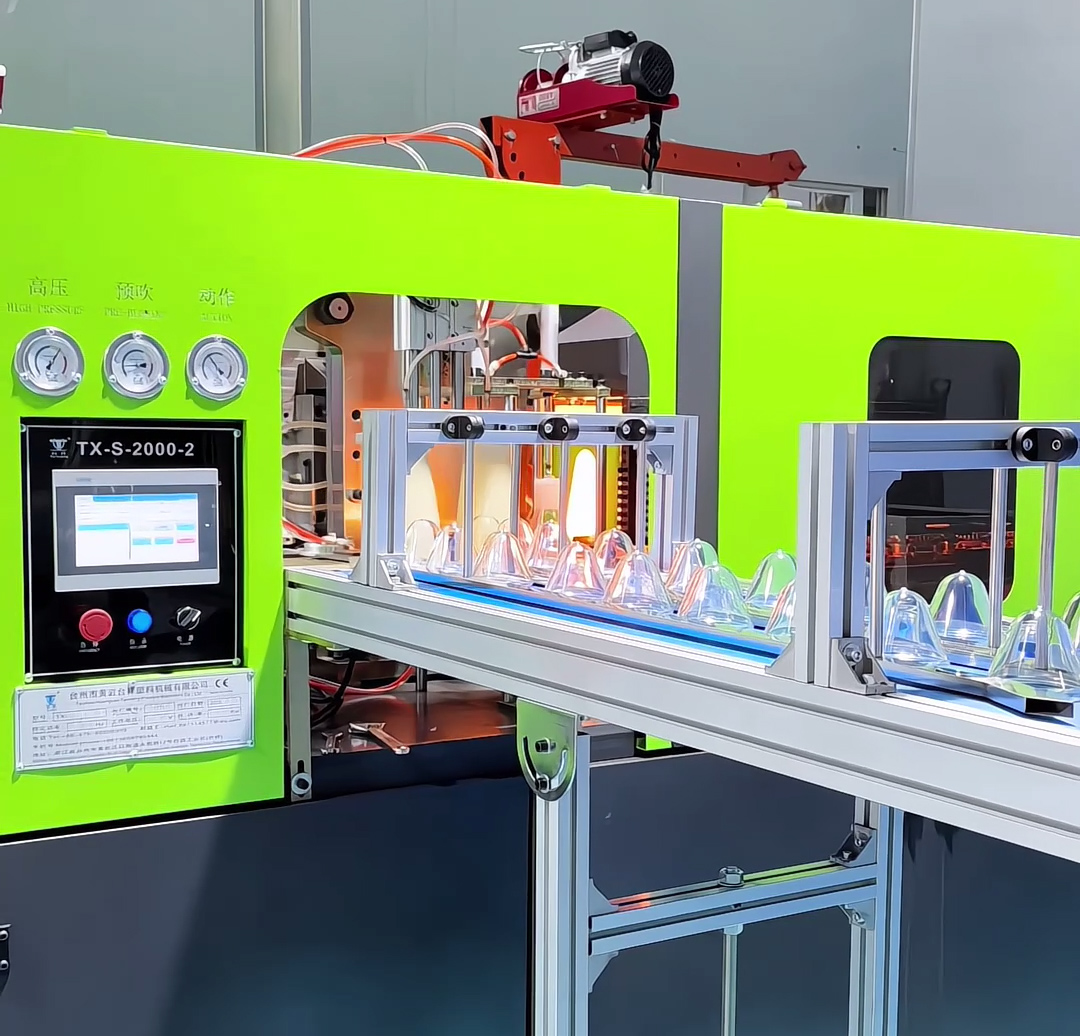
Servo vs Hydraulic Blow Molding Machine: Which Is Better for Your Factory?
By TAIXIANG MACHINE — Professional PET Blow Molding Machine Manufacturer
Last updated: 2026
Direct Answer: It Depends on Your Production Profile
The short answer is: Servo-driven blow molding machines are better for most modern PET bottle factories seeking lower operating costs, higher precision, and cleaner production environments. Hydraulic machines still make sense for factories with constrained capital budgets, very high-tonnage applications, or established maintenance ecosystems for hydraulic systems.
This analysis breaks down the technical and economic differences to help you make the right choice for your specific production scenario.
Understanding the Core Difference: Drive Technology
Both servo and hydraulic blow molding machines perform the same fundamental sequence: preform heating, stretching, mold clamping, high-pressure blowing, and ejection. The difference lies in how the mechanical motions are actuated.
Hydraulic Blow Molding Machine
A central hydraulic pump pressurizes oil, which is distributed through directional valves to cylinders that perform mold clamping, stretch rod movement, and other actuations. The oil pump runs continuously, even when the machine is idle between cycles.
Servo Blow Molding Machine
Independent servo motors drive mechanical linkages (typically ball screws or precision gears) for each motion. Power is delivered only when the motor is commanded to move, eliminating the constant idle load of a hydraulic pump [citation:9].
Head-to-Head Comparison: Servo vs Hydraulic for PET Blow Molding
| Factor | Servo Drive | Hydraulic Drive |
|---|---|---|
| Energy Consumption | 35–50% lower. No continuous pump load; power on demand [citation:9][citation:16] | High baseline draw. Pump runs constantly; motor efficiency often 40–60% [citation:16] |
| Cycle Time Consistency | Standard deviation within 0.1–0.2 seconds. Servo holds position regardless of temperature [citation:12] | Standard deviation 0.6–0.9 seconds. Oil viscosity drifts with temperature and filter condition [citation:12] |
| Positioning Accuracy | 0.03 mm positioning, ±0.05 mm tolerance [citation:16] | 0.05 mm positioning; hydraulic delay 300–500 ms per action [citation:16] |
| Maintenance | Low. No oil changes, no seal replacements. Ball screws last millions of cycles [citation:2][citation:19] | High. Periodic oil changes, seal replacement, filter maintenance, valve servicing [citation:16] |
| Cleanliness | Oil-free. Ideal for food, pharma, and sterile bottle production [citation:15][citation:16] | Oil leakage risk. Requires hydraulic oil management and spill containment [citation:16] |
| Noise Level | ≤ 75 dB. Quieter workshop environment [citation:16] | > 80 dB. Continuous pump noise plus valve chatter [citation:16] |
| Initial Investment | Higher upfront cost | Lower upfront cost [citation:16] |
| Best For | High-precision bottles, food/pharma, multi-SKU flexibility, long-term cost focus | Heavy-load applications, capital-constrained startups, single-SKU high-volume runs [citation:12] |
Energy Cost Analysis: The Numbers That Matter
Energy savings from servo technology are not marginal — they compound daily.
In a documented upgrade project, a hydraulic machine consuming 48.52 kWh was replaced with a servo-driven equivalent drawing 40.5 kWh — a 16.5% reduction in that specific application [citation:9]. In extrusion blow molding comparisons, servo machines demonstrate energy savings of 50–60% versus hydraulic equivalents [citation:16]. For PET stretch blow molding specifically, servo platforms typically consume 35–45% less power per thousand bottles [citation:12].
Consider a factory running 12,000 BPH (bottles per hour) on a 9-cavity machine like the TAIXIANG TX-114.3-9. At 20 hours per day, 300 days per year, even a conservative 30% energy reduction translates to substantial annual savings that directly improve your cost per bottle.
Precision and Bottle Quality: Why Servo Wins for PET
PET stretch blow molding is a precision process. The preform must be heated to a narrow temperature window (typically 80–120°C), stretched at a controlled rate, and blown with consistent pressure [citation:7]. Any inconsistency in motion control directly affects bottle wall thickness distribution, clarity, and mechanical strength.
Servo systems use electronic cams and PLC-controlled motion profiles. You can fine-tune the stretching curve via touchscreen without mechanical adjustments [citation:19]. This level of control is particularly valuable when switching between bottle designs — a few parameter taps replace the mechanical re-tuning required on hydraulic machines.
Hydraulic systems introduce inherent variability. Oil temperature changes throughout a shift, altering viscosity and therefore actuation speed. The result is drift in cycle timing and clamp force [citation:12]. For water bottles, this may be tolerable. For cosmetic or pharmaceutical bottles with tight tolerance requirements, servo is the more suitable drive [citation:12].
Maintenance and Downtime: The Hidden Cost Factor
Hydraulic systems have more wear points: pumps, valves, seals, hoses, filters, and oil itself. Each requires scheduled maintenance and eventual replacement. Oil changes alone — including disposal costs — add up over a machine's service life [citation:16].
Servo systems eliminate hydraulic oil entirely. The primary wear components are ball screws and bearings, which are sealed and designed for millions of cycles [citation:2]. One manufacturer reports 70% maintenance cost reductions versus hydraulic machines [citation:15].
For factories in regions with limited access to hydraulic technicians, servo systems also simplify the labor equation. PLC-based diagnostics and remote parameter fine-tuning support modern IoT-enabled production lines [citation:19].
When Hydraulic Still Makes Sense
Servo technology is not universally superior. Hydraulic blow molding machines retain advantages in specific scenarios:
- Heavy-load applications: Very high clamping forces for large industrial containers benefit from hydraulic power density [citation:16].
- Capital-constrained startups: Lower upfront cost may be the deciding factor when cash flow is tight [citation:12].
- Established maintenance ecosystems: In regions where hydraulic technicians and parts are abundant, the maintenance advantage of servo narrows [citation:12].
- Single-SKU, high-volume water bottle lines: When running one bottle design on three shifts with minimal changeovers, hydraulic machines can deliver acceptable total cost of ownership [citation:12].
TAIXIANG MACHINE: Your PET Blow Molding Solution Partner
TAIXIANG MACHINE designs and manufactures fully automatic and semi-automatic PET blow molding machines from our factory in Taizhou, Zhejiang, China. We serve over 80 countries with machines ranging from 2 to 9 cavities and outputs up to 12,000 BPH [citation:1].
Our servo-equipped automatic PET blow molding machines feature:
- Advanced IR heating with multi-zone control for consistent preform temperature [citation:1]
- Stable servo performance for repeatable cycle times
- Smart PLC touchscreen control with real-time monitoring
- Quick mold change systems for multi-SKU flexibility
- Energy savings up to 30% versus conventional heating [citation:1]
We also manufacture semi-automatic PET blow molding machines for small-to-medium production, with outputs from 300 to 2,500 BPH and volumes up to 5 gallons [citation:4].
Why factories choose TAIXIANG: ISO 9001 certification, CE compliance, 3-year main parts warranty on automatic models, and lifetime technical support. Our engineering team helps you match the right drive technology to your actual production requirements — not a one-size-fits-all recommendation.
Frequently Asked Questions
Is a servo blow molding machine worth the higher upfront cost?
For most factories running regular production, yes. The energy savings alone often provide payback within 12–24 months. Reduced maintenance and higher uptime improve the business case further. If you run one shift per day or have very tight capital constraints, hydraulic may be the practical starting point.
Can I switch from hydraulic to servo on an existing line?
Retrofitting is possible but rarely cost-effective for PET blow molding machines. The drive architecture is fundamentally different. For new capacity, choosing servo from the start is the better investment.
What bottle types benefit most from servo precision?
Cosmetic bottles, pharmaceutical containers, and any application requiring consistent wall thickness and visual quality. Wide-mouth jars and hot-fill bottles also benefit from tighter process control.
Does TAIXIANG offer both servo and hydraulic options?
Yes. We manufacture servo-driven automatic machines and also offer hydraulic configurations for specific applications. Our engineering team will recommend the drive system that best fits your bottle specs, production volume, and budget.
Conclusion: The Right Choice Is Application-Specific
Servo technology has become the default for new PET blow molding installations in most markets because it delivers measurable advantages in energy, precision, and maintenance. Hydraulic machines remain viable for specific high-load or capital-constrained scenarios.
The critical step is matching the technology to your actual production profile. TAIXIANG MACHINE has manufactured PET blow molding equipment for decades and has helped factories across Asia, Africa, South America, and beyond select the right configuration [citation:18]. We do not push a single technology — we solve production problems.
Contact TAIXIANG MACHINE for a factory assessment and machine recommendation tailored to your bottle specifications, target output, and budget.