read the article

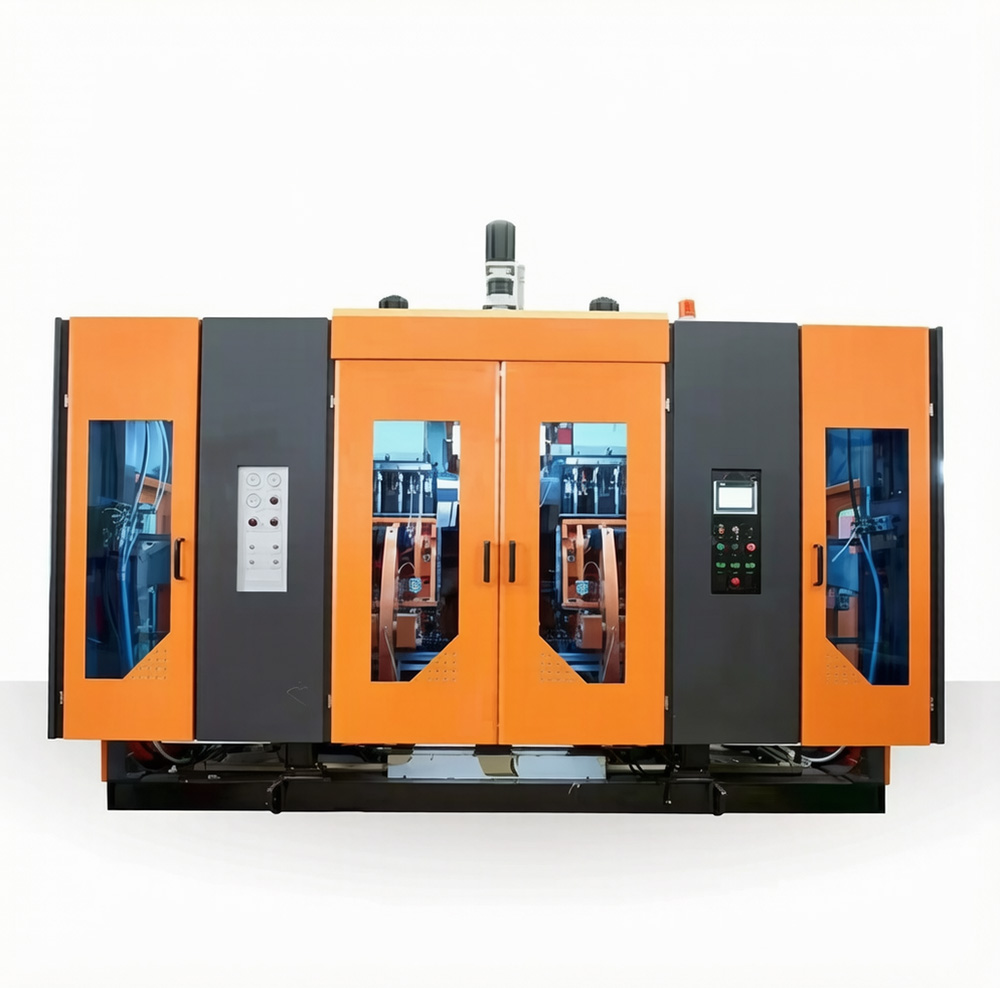
Direct Answer: For most startups entering PET bottle production below 1,500 bottles per hour, a semi-automatic machine pays back faster because the capital saved outweighs the labor cost difference during the ramp-up phase. The crossover point where a fully automatic machine becomes the cheaper choice in total cost of ownership typically falls between 2,000 and 3,000 BPH of sustained, consistent output—or when labor availability becomes a binding constraint rather than a cost line. TAIXIANG manufactures both machine categories, which means our engineering team has no incentive to push a startup toward automation before the volume justifies it.
TAIXIANG has manufactured PET blow molding machines since 2014, with product lines spanning semi-automatic models from 1 to 4 cavities and fully automatic machines from 2 to 9 cavities [citation:1][citation:2][citation:3]. The company’s export footprint covers 60+ countries for semi-automatic equipment and 80+ for automatic lines, which gives us a broad view of how startups actually deploy these machines—not how they are marketed.
This analysis examines the payback question from the perspective of a founder or operations manager who has a bottle design, a target market, and limited capital. The decision is not “which machine is better.” It is “which machine makes money sooner given the production volume I can actually sell.”
The Startup Reality: Volume Ramp-Up Changes the Math
Most payback comparisons assume steady-state production at rated capacity. Startups do not operate that way. A new bottling operation typically spends the first 6–12 months building distribution, adjusting formulations, and absorbing reject rates that are higher than a mature plant’s. The machine that looks cheaper on a per-bottle basis at 8,000 BPH may be the more expensive choice if the startup is running at 1,200 BPH for the first year.
The semi-automatic value proposition is straightforward: lower capital at risk during the period when volume is uncertain. TAIXIANG’s semi-automatic product page states a payback period “typically achieved within 3-6 months” for its target customer profile—small to medium-scale producers with modest initial volume requirements [citation:2]. That claim depends on the machine being utilized near its capacity, which is precisely the assumption a startup must validate before committing capital.
What Semi-Automatic Actually Means in Practice
The operational difference between the two machine types is not a vague “less automation.” It is specific and measurable:
| Operational Factor | Semi-Automatic (TAIXIANG TX Series) | Fully Automatic (TAIXIANG TX-106/TX-114 Series) |
|---|---|---|
| Preform loading | Manual loading by operator | Automatic feeding via unscrambler/conveyor |
| Bottle removal | Manual removal; auto-drop available on select models [citation:2] | Automatic ejection to conveyor or collection table |
| Operator attention | Continuous; operator is part of the production cycle | Monitoring and quality check; operator intervenes on fault only |
| Typical output range | 300–2,500 BPH depending on model [citation:2] | 1,500–12,000 BPH depending on cavity count [citation:3] |
| Cavity options | 1–4 cavities | 2–9 cavities |
| Labor per machine | 1 operator (dedicated during run) | 1 operator can attend multiple machines or perform secondary tasks |
The labor difference is the dominant variable in the payback calculation. A semi-automatic machine requires an operator who is physically engaged in the production cycle—loading preforms, removing bottles, inspecting output. A fully automatic machine frees that operator to perform other tasks, or to oversee additional machines. For a startup where the founder is also the production manager, this distinction matters less in the first year and more in the second.
TAIXIANG engineering note: The TX-5L semi-automatic model with auto-drop feature represents a middle path that is often overlooked. It retains manual preform loading but automates bottle ejection, reducing one labor-intensive step without the full capital commitment of a fully automatic line. For startups producing large containers (5L–20L) at modest volumes, this configuration often provides the best labor-to-capital balance [citation:2][citation:9].
The Payback Calculation: Two Scenarios with Real Numbers
The payback question cannot be answered without numbers. The following analysis uses TAIXIANG’s published specifications and industry-standard operating assumptions to illustrate the decision framework. The numbers are illustrative—a startup should substitute its own labor rates, energy costs, and volume forecasts.
Scenario A: Water Bottle Startup, 1,000 BPH Target
A startup targeting 1,000 BPH of 500ml water bottles, operating 8 hours per day, 25 days per month. This is a modest operation—roughly 200,000 bottles per month at 100% utilization, or 170,000 at 85% realistic utilization.
| Cost Factor | Semi-Automatic (TX-1.5L-4 Cavity) | Fully Automatic (TX-106-2, 2 Cavity) |
|---|---|---|
| Machine price (est.) | $8,000–12,000 | $18,000–25,000 |
| Rated output | 1,000–2,500 BPH [citation:2] | 1,500–2,500 BPH [citation:3] |
| Actual output at startup volume | ~1,000 BPH (machine can run faster; demand-limited) | ~1,000 BPH (machine runs below capacity) |
| Operators required | 1 dedicated (part of cycle) | 1 monitoring (can multitask) |
| Monthly labor cost (est., $6/hr, 200 hrs) | $1,200 | $1,200 (same operator, but can perform other tasks) |
| Energy consumption | Lower connected load; ~25% less power claimed for semi-auto [citation:2] | Higher connected load but servo efficiency [citation:3] |
| Payback period (simplified) | Faster—lower capital, adequate output for demand | Slower—higher capital, output exceeds demand in year one |
At 1,000 BPH demand, the fully automatic machine’s advantages—higher maximum output, lower labor per bottle at scale—do not materialize. The machine runs below its rated capacity, and the capital premium sits idle. The semi-automatic machine produces the same bottles at lower capital cost, and the operator labor is a fixed cost regardless of which machine is used.
Scenario B: Same Startup, Year Two, 3,000 BPH Demand
Demand has grown. The startup now needs 3,000 BPH, which requires either two semi-automatic machines running in parallel (with two dedicated operators) or one fully automatic machine running at capacity (with one monitoring operator).
| Cost Factor | 2× Semi-Automatic (2 machines) | 1× Fully Automatic (4-cavity) |
|---|---|---|
| Capital required | ~$16,000–24,000 | ~$35,000–50,000 |
| Operators | 2 dedicated | 1 monitoring |
| Monthly labor cost | $2,400 | $1,200 |
| Annual labor difference | — | $14,400 saved |
| Payback of automation premium | — | ~2–3 years from labor savings alone, faster if reject rate improves |
At 3,000 BPH sustained demand, the labor savings from automation begin to justify the capital premium. The fully automatic machine’s higher output capacity is now utilized, and the labor reduction becomes a real operating cost advantage. The payback period depends on the exact capital difference and local labor rates—in higher-wage markets, the crossover comes sooner; in lower-wage markets, it comes later.
The crossover point in practice: TAIXIANG’s product positioning reflects this reality. The semi-automatic line is marketed for “small to medium-scale bottle production” and explicitly targets startups [citation:2]. The fully automatic entry model (TX-106-2, 2 cavities) is described as “perfect for startups and small production lines” but at 1,500–2,500 BPH—a range where the machine is already at its capacity limit, not idling [citation:3]. The 4-cavity and higher models are where automation’s scale economics become dominant.
What the Payback Math Misses: Hidden Factors That Favor One or the Other
Pure cost-per-bottle comparisons omit operational realities that determine whether a machine actually makes money. Three factors deserve explicit consideration.
1. Labor Availability vs. Labor Cost
In regions where finding reliable operators is difficult—not just expensive—automation provides value that the cost calculation does not capture. A semi-automatic machine that sits idle because no one showed up for the shift produces zero bottles. A fully automatic machine that requires only monitoring can run with a smaller, more flexible workforce. For startups in labor-scarce markets, the fully automatic premium may pay back in uptime rather than in wage savings.
2. Reject Rate and Consistency
TAIXIANG’s fully automatic specifications emphasize “precise temperature control for consistent bottle quality” and “smart PLC control” with real-time monitoring [citation:3]. A semi-automatic machine relies on the operator’s judgment for heating adjustment and quality inspection. For startups producing bottles for regulated markets or brand-sensitive customers, the consistency advantage of automation can reduce reject rates and customer complaints—both of which have costs that do not appear in the machine’s price tag.
3. Mold Compatibility and Changeover Frequency
A startup producing multiple bottle sizes or designs on one machine will change molds frequently. TAIXIANG’s semi-automatic line advertises “quick mold change—switch in minutes” [citation:2], while the fully automatic line also emphasizes quick changeover [citation:3]. The practical difference depends on the specific mold interface and the operator’s familiarity. For a startup testing multiple SKUs in the first year, a semi-automatic machine with low changeover friction may be more flexible than an automatic line optimized for long runs of a single bottle.
Decision Framework: Three Questions Before Choosing
The payback question resolves to three practical tests. If the answer to all three points toward automation, the higher capital is justified. If any answer points toward semi-automatic, the lower-risk path is likely correct for the startup phase.
| Question | Semi-Automatic Signal | Fully Automatic Signal |
|---|---|---|
| What is your committed monthly volume, not your target? | Below 200,000 bottles/month; demand still building | Above 300,000 bottles/month; contracts or distribution secured |
| Can you staff a dedicated operator reliably? | Yes; labor available and cost is manageable | No; labor scarce, turnover high, or operator time better spent elsewhere |
| How many SKUs in the first 12 months? | Multiple designs or sizes; changeover frequency high | One or two core bottles; long production runs |
If the answers are mixed—for example, moderate volume but reliable labor—the TX-5L auto-drop semi-automatic model or a 2-cavity fully automatic entry model may represent the practical middle ground. TAIXIANG’s product range includes configurations at both ends of this transition, which means the recommendation can be based on the customer’s actual situation rather than on pushing them toward a single platform [citation:2][citation:3].
Frequently Asked Questions
At what production volume does a fully automatic PET blow molding machine pay back faster than semi-automatic?
Based on labor cost savings alone, the crossover typically falls between 2,000 and 3,000 BPH of sustained demand, depending on local wage rates. In higher-wage markets, the crossover may come at 1,500 BPH; in lower-wage markets, it may not come until 4,000 BPH or higher. The calculation should include the cost of unreliable labor (downtime when an operator is absent) and the value of consistency in reject rates.
Can a semi-automatic machine be upgraded to automatic later?
Not in a cost-effective way. The automation in a fully automatic machine is integrated into the machine’s design—preform feeding, bottle removal, and control logic are engineered as a system. Retrofitting a semi-automatic machine to automatic operation typically costs more than the price difference between the two machines when purchased new. Startups should choose based on their realistic 12–24 month volume forecast, not on a plan to upgrade.
What is the minimum realistic output for a startup using a semi-automatic machine?
A single-cavity semi-automatic machine can produce as few as 300–600 BPH for large containers, or 700–1,200 BPH for smaller bottles [citation:2][citation:9]. For a startup testing market demand, this range is often sufficient. The key is that the machine can run at the startup’s actual demand level without the capital penalty of an underutilized automatic line.
Does TAIXIANG provide payback calculations for specific customer scenarios?
TAIXIANG’s technical team supports customers in evaluating machine selection based on their target bottle, volume forecast, and local operating costs. The company manufactures both semi-automatic and fully automatic lines, so the recommendation is based on the application rather than a single product platform.