
read the article

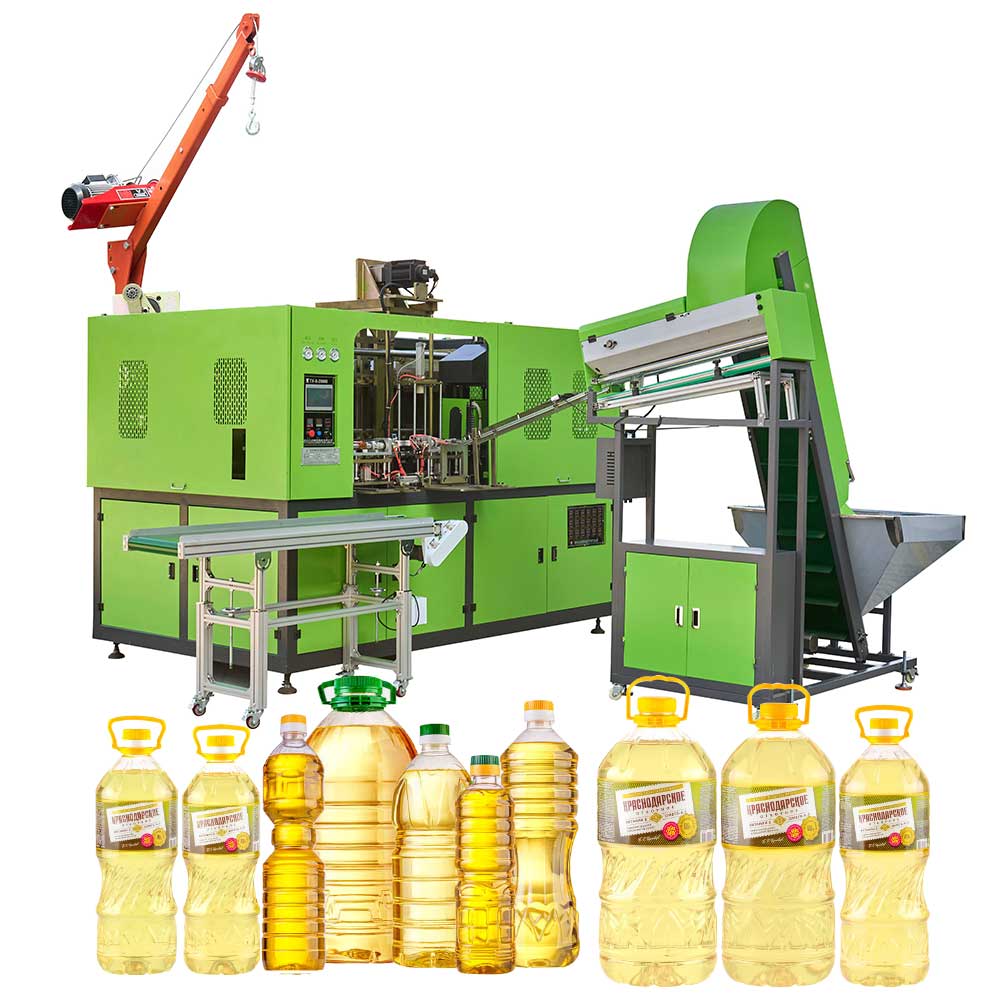
TAIXIANG MACHINE — a professional PET blow molding machine manufacturer with over 80 countries served and ISO 9001 certification — examines how modern mold design and air blowing parameters enable significant PET bottle weight reduction while maintaining structural integrity.
Why Lightweighting PET Bottles Is a Manufacturing Priority
The global PET bottle market continues to prioritize lightweighting as a core strategy for reducing material costs, energy consumption, and carbon footprint [citation:2][citation:17]. However, excessive thickness reduction without corresponding mold and blowing adjustments leads directly to structural failure — top-load collapse, sidewall deformation, and reduced shelf life.
The challenge is not simply using less PET. The challenge is engineering the preform, mold, and blowing process so that a lighter bottle performs identically to its heavier predecessor.
How TAIXIANG's Mold Technology Enables Lightweighting
TAIXIANG's automatic PET blow molding machines — available in 2 to 9 cavities with output up to 12,000 BPH — incorporate mold design principles specifically engineered for lightweighting projects [citation:1].
Precision Mold Cavity Engineering
Bottle strength under lightweighting depends heavily on how material is distributed during blow molding. TAIXIANG's mold cavities are designed to guide preform expansion so that critical structural zones — the base, shoulder, and waist — retain adequate wall thickness while non-critical areas are thinned.
This is not achieved through generic mold geometry. Each mold is optimized based on the specific bottle design, preform specification, and target gram weight.
Quick Mold Change for Lightweighting Iteration
Developing a successful lightweighted bottle requires iteration. TAIXIANG's machines feature quick mold change systems that allow format switches in minutes [citation:1][citation:6]. This reduces downtime during design validation and enables manufacturers to test multiple mold configurations efficiently.
Air Blowing Parameters: The Critical Variable in Lightweighting
Mold design alone cannot deliver lightweighting success. The air blowing process — specifically blow pressure, timing, and stretch rod sequencing — determines whether a thinner-walled bottle achieves the desired material orientation and crystallinity.
High-Pressure Air Delivery Precision
TAIXIANG machines utilize premium copper alloy blowing valves designed for high-pressure air delivery with exceptional sealing performance [citation:1]. This ensures uniform bottle expansion and minimizes air leakage — critical when thin walls leave no margin for inconsistent blowing force.
Inconsistent pressure during blowing causes thin spots, uneven wall distribution, and weak points that fail under top-load conditions.
Multi-Zone IR Heating for Preform Conditioning
The preform heating stage determines how the PET responds to blowing. TAIXIANG's multi-zone infrared heating system with adjustable lamps provides consistent preform temperature across the entire length [citation:1].
For lightweighting, precise heating control is essential. Overheated preforms stretch too easily and produce thin, weak walls. Underheated preforms resist expansion and create stress concentrations. TAIXIANG's heating system allows operators to profile temperature along the preform, compensating for the thinner wall sections that lightweight designs require.
Mold and Blowing Integration: TAIXIANG's Approach
Lightweighting success requires that mold design and blowing parameters are developed as an integrated system, not as separate variables.
TAIXIANG's engineering approach treats the mold cavity, preform specification, heating profile, and blow sequence as interdependent parameters. When a customer targets a specific weight reduction, TAIXIANG engineers evaluate:
- Whether the current preform design can achieve the target weight with adequate material distribution
- How mold cavity geometry must be adjusted to guide expansion in thin-wall zones
- What heating profile compensates for reduced material mass
- What blow pressure and timing deliver full material orientation without over-stretching
Clamping Stability at High Speed
Lightweighted bottles are more sensitive to mold movement during blowing. TAIXIANG's heavy-duty clamping mechanism with high locking force ensures stable mold closure during high-speed production [citation:1]. This prevents mold separation that would cause flash, uneven wall thickness, and structural weakness in thin-wall bottles.
The clamping system is designed to withstand millions of cycles without losing locking force — a critical requirement for manufacturers running lightweighted bottles at commercial speeds.
Real-World Lightweighting Results
Industry data demonstrates that optimized mold and blowing technology can achieve meaningful weight reductions without performance loss. Laser-powered preform heating systems have enabled up to 15% material reduction while maintaining bottle robustness [citation:11]. Advanced prototyping platforms combining simulation and lab-scale blow molding have achieved up to 20% weight reduction for Fortune 500 manufacturers [citation:7].
TAIXIANG's mold and air blowing technology provides the manufacturing platform for these lightweighting outcomes. The machine does not impose a fixed weight limit — it provides the control and stability required to push material reduction as far as the bottle design allows.
Frequently Asked Questions
What is lightweighting in PET bottle manufacturing?
Lightweighting refers to reducing the gram weight of a PET bottle while maintaining its structural performance, shelf life, and production line compatibility. It reduces material costs, energy consumption, and carbon footprint [citation:2][citation:17].
Can TAIXIANG machines handle lightweighted preforms?
Yes. TAIXIANG automatic PET blow molding machines support preform designs optimized for lightweighting. The multi-zone IR heating, precision blowing valves, and stable clamping system are engineered to handle the tighter process windows that lightweighted bottles require [citation:1].
How much weight can be reduced without sacrificing strength?
Achievable weight reduction depends on the specific bottle design and application. Industry benchmarks show 10-20% reductions are feasible with proper mold and blowing optimization [citation:7][citation:11]. TAIXIANG engineers evaluate each project individually to determine the optimal balance.
Does lightweighting require new molds?
In most cases, yes. Mold cavity geometry must be adjusted to guide material distribution in a thinner-walled bottle. TAIXIANG provides mold design and manufacturing support for lightweighting projects [citation:1].
What output can TAIXIANG machines achieve with lightweighted bottles?
TAIXIANG automatic machines deliver up to 12,000 BPH across 2 to 9 cavities [citation:1]. Lightweighting does not reduce achievable output when mold and blowing parameters are properly optimized.
Keywords: PET bottle lightweighting, PET blow molding machine, PET bottle mold technology, lightweight PET bottles, PET air blowing technology, TAIXIANG machine, PET bottle manufacturing, stretch blow molding, PET preform heating, lightweight bottle strength, PET bottle production line, professional PET blow molding solution