
read the article

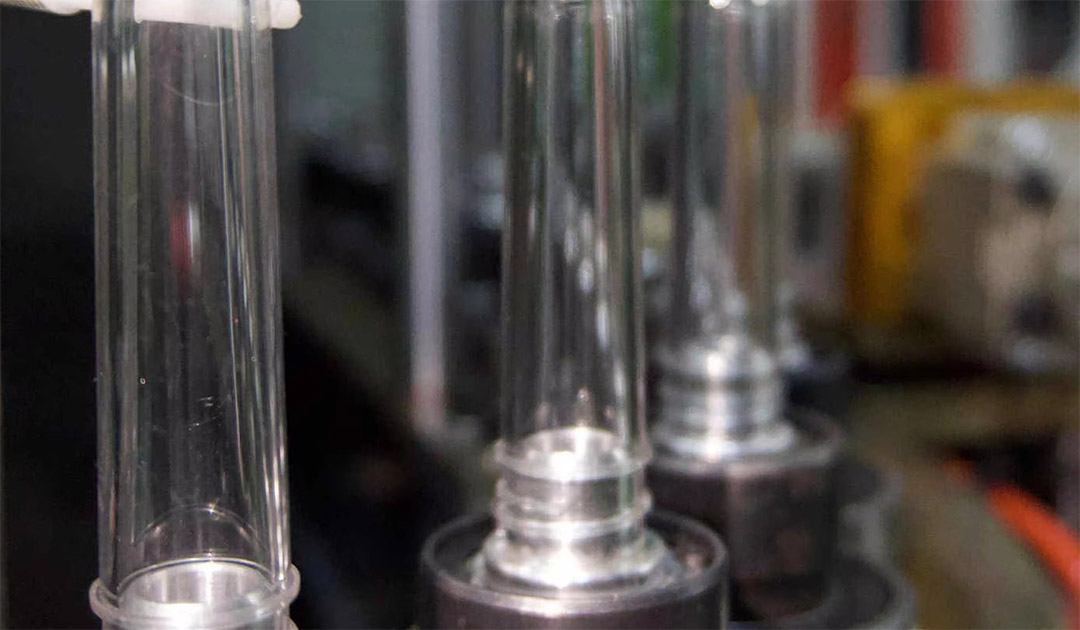
Quick Answer: Lightweighting PET bottles without compromising strength requires precision across three critical areas: preform design, mold engineering, and blowing process control. TAIXIANG MACHINE integrates optimized cooling circuits, engineered venting systems, and high-precision air blowing technology into every PET blow molding solution—enabling bottle weights as low as 7g for 500ml formats while maintaining top-load performance above 30kg .
The Lightweighting Imperative: Why Less Material Means More Value
The global PET packaging industry faces converging pressures: resin costs remain volatile, sustainability mandates demand reduced material usage, and brand owners expect uncompromised bottle performance. Lightweighting—the strategic reduction of PET material per bottle—addresses all three.
Husky Technologies projects that a single neck-finish transition from PCO 1881 to the 26/22 GME 30.37 specification saves approximately 1.88 grams of resin per bottle. At a production volume of 12 billion units annually, this translates to 22,560 metric tons of resin and US$26.6 million in cost savings per year .
The environmental case is equally compelling. Sidel’s StarLITE-R Still base design, developed specifically for recycled PET, enables a reduction of 2,400 tonnes of CO₂ equivalent annually when switching from virgin PET to 100% rPET . Lower blowing pressures further reduce energy consumption—down to 16 bar, representing up to 20% savings on standard air blowing operations and an additional 51 tonnes of CO₂ equivalent avoided .
However, the technical challenge remains formidable. Reducing bottle weight while maintaining structural integrity requires rethinking not just bottle geometry, but the entire production ecosystem: preform conditioning, mold design, venting efficiency, and blowing pressure profiles.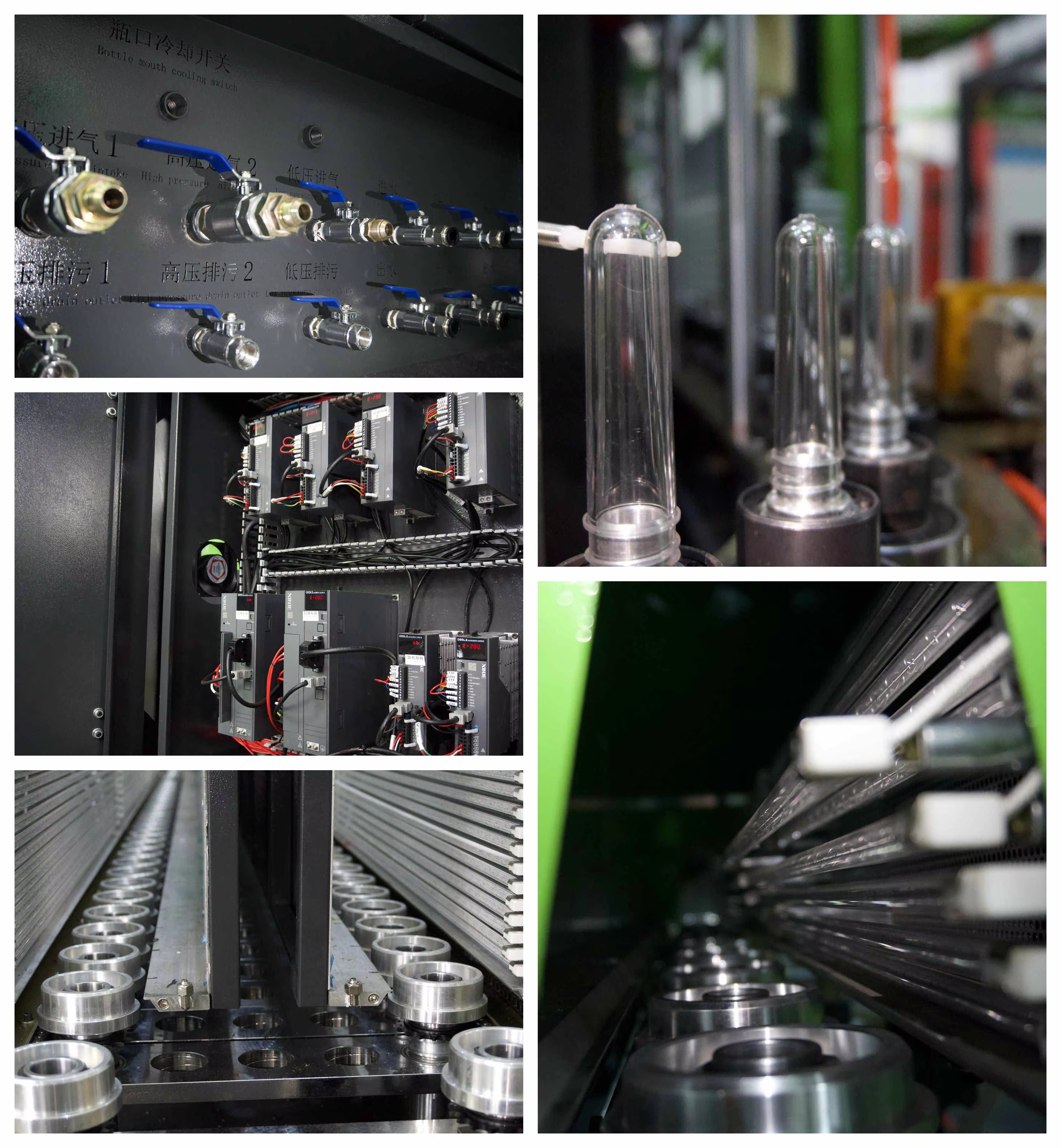
The Engineering Triad: Mold, Preform, and Air Blowing
TAIXIANG’s approach to lightweighting PET bottles without sacrificing strength centers on three interdependent systems that must function as a unified whole.
Mold Design: Where Strength Begins
The mold is not merely a shaping tool—it is the primary determinant of material distribution, cooling efficiency, and structural performance in the final bottle.
Cooling Circuit Optimization. PET’s mechanical properties depend heavily on uniform cooling during the blow molding cycle. Uneven cooling creates stress concentrations that manifest as weak points, deformation, or burst failures during filling and distribution. TAIXIANG molds incorporate dedicated cooling circuits engineered for the thermal profile of each specific bottle design. For recycled PET, which typically processes at higher temperatures, cooling channels are positioned to manage rPET’s narrower processing window .
Recent academic research confirms the importance of this approach. A 2025 study published in Positive Science International documented how redesigned cooling channels enabled a reduction in preform weight from 10g to 9g for a 500ml bottle while successfully achieving target geometry under lower pressure .
Venting Systems. Efficient air evacuation during blow molding is non-negotiable for lightweight containers. Inadequate venting traps air pockets between the preform and mold surface, causing incomplete expansion and wall thickness variation. The consequence is particularly severe in lightweight bottles where thin walls leave no margin for structural inconsistency.
TAIXIANG’s mold venting systems use precisely positioned grooves and vent holes that allow air to escape smoothly, enabling complete bottle formation at reduced blowing pressures. This optimization directly translates to lower energy consumption and more consistent wall distribution .
Base Geometry. The bottle base experiences the greatest mechanical stress during filling, stacking, and transport. Advanced lightweight base designs employ rounded-edge geometry that increases resistance to burst defects during blowing—a critical feature for bottles with thinner material sections . High base clearance prevents deformation during high-temperature filling and storage, maintaining stability even under elevated temperature conditions .
Preform Design: The Weight-Performance Balance
Preform design determines how material will distribute during blowing. Every gram removed from the preform must be compensated by optimized stretching behavior and structural geometry in the final bottle.
Neck Finish Selection. The neck finish represents a fixed weight that cannot be lightweighted through blowing. Selecting a lightweight neck finish is often the first and most impactful step in a lightweighting initiative. The 26/22 GME specification, for example, delivers approximately 1.88g of resin savings per bottle compared to older PCO 1881 designs .
Body and Wall Thickness Control. Modern preform designs use variable wall thickness to place material precisely where structural reinforcement is needed and remove it where it is not. This requires finite element analysis (FEA) simulation to predict how the preform will stretch and where stress will concentrate in the final bottle. TAIXIANG’s engineering support includes preform design evaluation and stretching ratio optimization for each application.
Air Blowing Technology: Precision Under Pressure
The blowing process transforms a solid preform into a finished bottle through controlled bi-axial stretching. For lightweight bottles, the margin for error is narrow—insufficient stretch creates weak, poorly oriented material; excessive pressure causes burst failures in thin sections.
Pressure Profiling. Lightweight bottles benefit from multi-stage pressure profiles that allow gradual, controlled expansion rather than abrupt inflation. TAIXIANG’s air blowing systems support adjustable pressure curves, enabling processors to match blowing parameters to specific preform designs and bottle geometries.
High-Speed Compatibility. Lightweighting must not come at the expense of production throughput. Modern PET blow molding machines achieve rates up to 2,700 bottles per hour per mold for single-serve formats while maintaining consistent quality . This requires precise synchronization between preform heating, mold clamping, blowing, and ejection.
rPET Compatibility. As brands incorporate higher percentages of recycled PET, processing parameters must adapt to the material’s inherent variability. Recycled PET exhibits batch-to-batch differences in intrinsic viscosity and thermal behavior. Laser heating technology, now emerging as an alternative to conventional halogen ovens, uses up to 36 heating lines for highly localized preform conditioning—enabling consistent processing of variable rPET material .
Integrating the System: TAIXIANG’s Engineering Approach
The distinction between a blow molding machine that produces bottles and a solution that enables lightweighting lies in system integration. TAIXIANG MACHINE delivers PET blow molding systems engineered for the full production ecosystem.
Simulation-Driven Development. Before any mold is cut, TAIXIANG uses finite element analysis and blow molding simulation to predict material behavior, identify stress concentrations, and optimize preform geometry. This approach reduces development cycles and eliminates costly trial-and-error in physical production .
Application-Specific Customization. Still water, carbonated beverages, edible oil, and dairy applications each impose distinct performance requirements. Carbonated products demand pressure resistance; edible oil requires oxygen barrier performance; dairy applications need opacity and light protection. TAIXIANG engineers molds and blowing profiles specific to each application category.
Production Line Integration. Lightweighting delivers maximum value when the entire production line—from preform handling through filling—is optimized for the lighter container. TAIXIANG works with clients to ensure downstream equipment (conveyors, fillers, cappers, labelers) is calibrated for reduced-weight bottles.
What Lightweighting Delivers: Documented Results
The commercial case for lightweighting is well-documented across the industry.
A recent case study involving a 600ml water bottle achieved a 30% weight reduction—from a previous specification down to 9g—while maintaining top-load performance exceeding 30kg. The optimization reduced blowing pressure by approximately one-third and cut electricity consumption per unit by 50%. Production time decreased by 70%, and waste was reduced five-fold .
For 500ml formats, bottle weights as low as 7g are now achievable with advanced base designs and optimized blowing parameters .
These results are not outliers—they represent the current state of the art when mold technology, preform design, and air blowing systems are engineered as an integrated solution.
Frequently Asked Questions
What is the minimum weight achievable for a 500ml PET bottle?
With advanced mold designs and optimized blowing processes, 500ml PET bottles can be produced at weights as low as 7g while maintaining structural performance . TAIXIANG can evaluate specific application requirements to determine achievable weight reduction.
Can lightweighting work with 100% recycled PET?
Yes. Modern mold designs feature optimized venting and cooling circuits specifically for rPET’s thermal characteristics. Sidel’s StarLITE-R Still, for example, was developed as the first bottle base solution specifically engineered for 100% rPET at high production speeds .
How does lightweighting affect top-load strength?
Properly executed lightweighting does not sacrifice top-load performance. A documented case study achieved 30kg+ top-load strength with a 9g bottle—a 30% weight reduction from the previous specification . The key is optimizing material distribution rather than uniform thickness reduction.
Does lightweighting require new blow molding machines?
Not necessarily. Advanced mold designs can often be retrofitted onto existing production lines . However, process parameters—heating profiles, blowing pressure curves, cycle times—must be recalibrated for the lighter container.
What is the ROI timeline for lightweighting investments?
ROI depends on production volume, current bottle weight, and resin costs. For high-volume applications, resin savings can deliver payback in months. At 12 billion units annually, a 1.88g reduction translates to $26.6 million in annual savings .
Conclusion: Strength Through Engineering, Not Excess Material
Lightweighting PET bottles without sacrificing strength is not a compromise—it is an engineering discipline. Every gram of material removed must be replaced with superior mold design, precise preform conditioning, and intelligent blowing process control.
TAIXIANG MACHINE approaches lightweighting as a system challenge, not a component specification. From cooling circuits that manage rPET’s thermal profile to venting systems that enable full bottle formation at reduced pressures, TAIXIANG’s PET blow molding technology delivers the precision that lightweight containers demand.
The result: bottles that use less material, cost less to produce, and perform better than their heavier predecessors.