read the article

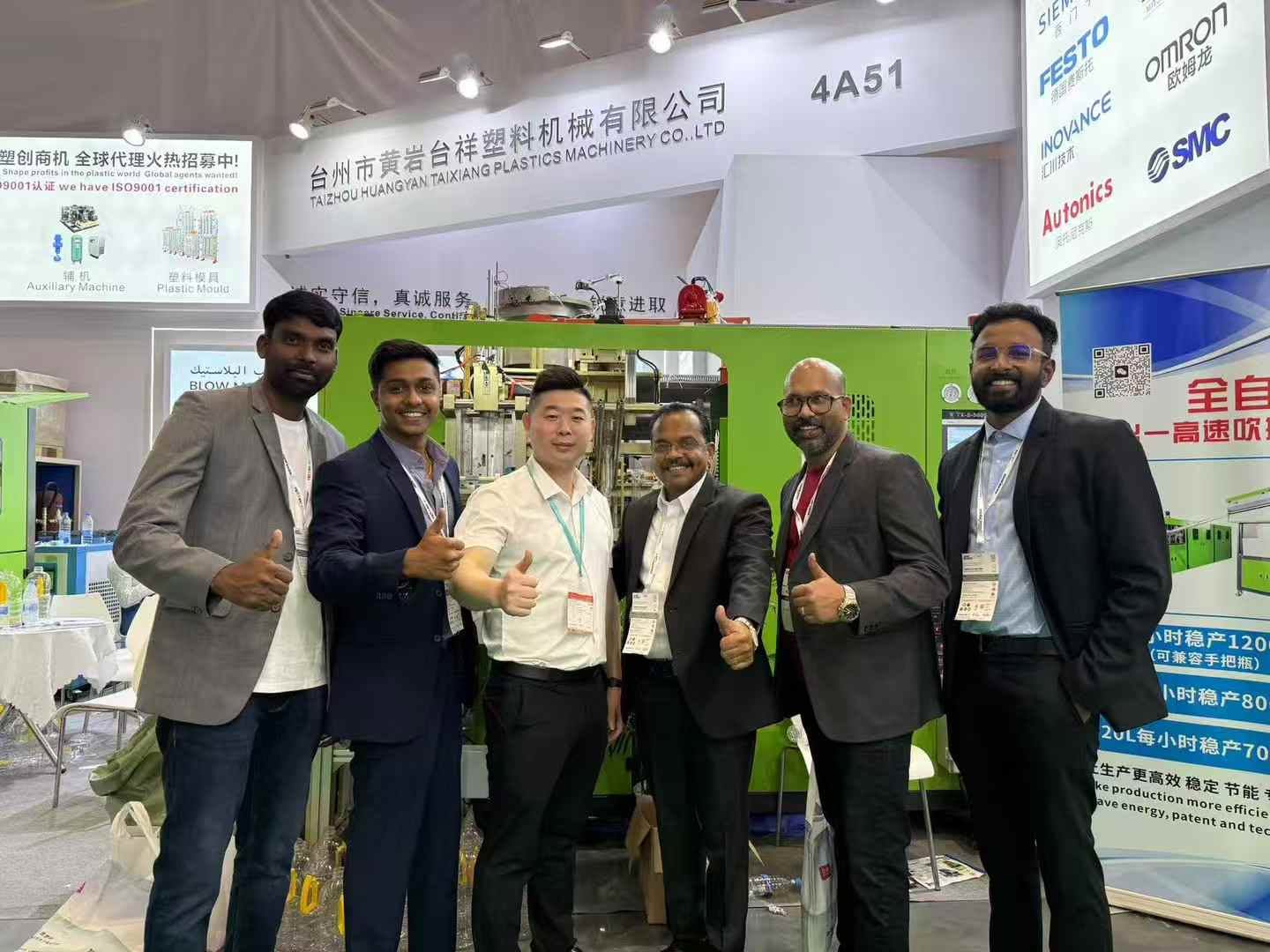
Case Study: Carbonated Soft Drink Bottle Solution for a Client in India
Published by TAIXIANG MACHINE — PET Blow Molding Solution Specialists
How a mid-sized Indian beverage producer achieved 4.0 MPa pressure resistance and 22% energy savings with a customized semi-automatic PET blowing system.
1. Project Background & The Carbonation Challenge
In late 2024, a beverage manufacturer based in Gujarat, India, approached TAIXIANG MACHINE with a specific technical bottleneck. The client was producing carbonated soft drinks (CSD) in 1.25L and 2L PET formats for the domestic market. While their existing general-purpose blowing equipment could produce water bottles adequately, it consistently failed on carbonated applications.
The core issue was stress cracking and base deformation. Carbonated soft drinks require internal pressure retention of approximately 3.5 to 4.0 MPa (approximately 35–40 bar) depending on the carbonation volume and storage temperature [citation:8][citation:11]. The client’s previous machine lacked the clamping force stability and precise heat profile control necessary to produce bottles with the required material distribution—specifically the thicker, more crystalline base and petaloid geometry essential for pressure resistance.
2. Technical Diagnosis: Why Standard Machines Fail on CSD
Before proposing a solution, our engineering team conducted a remote audit of the client’s production data and bottle samples. We identified three critical deficiencies:
2.1 Insufficient Clamping Force & Mold Rigidity
Carbonated bottles demand significantly higher clamping force to prevent mold separation during the high-pressure blowing phase. The client’s existing machine offered a clamping force that was adequate for still water but marginal for CSD. Under the 4.0 MPa blow pressure, the mold halves exhibited micro-separation, leading to inconsistent wall thickness and visible parting-line flash.
2.2 Inadequate IR Heating Profile for Petaloid Bases
The petaloid base—the five-footed structure at the bottom of a CSD bottle—must be significantly thicker and more crystalline than the sidewall to withstand pressure without inversion. The client’s single-zone heating approach overheated the base, causing excessive stretching and thinning at the critical stress points.
2.3 Blow Pressure Instability
CSD production requires a stable, high-pressure air supply with precise pre-blow and final-blow staging. Fluctuations in the client’s compressed air system resulted in inconsistent bottle expansion, contributing to a 4.2% rejection rate.
3. The TAIXIANG Solution: TX-2L-CSD Configuration
Based on the client’s production target of 1,800–2,200 BPH and their budget constraints as an independent bottler, we configured a solution centered on our semi-automatic PET blowing machine platform, specifically optimized for CSD applications.
3.1 Machine Selection: Semi-Automatic 4-Cavity Platform
While fully automatic machines are prevalent in high-volume CSD lines, the client’s batch-oriented production model and limited floor space made a semi-automatic configuration economically superior. We specified a 4-cavity unit from our proven semi-automatic series, which offers a theoretical output of up to 2,500 BPH for 1.5L formats and supports the clamping forces required for carbonated applications [citation:1].
Key mechanical specifications deployed:
- Clamping Force: 13 Ton (upgraded from the standard 10T configuration to ensure mold integrity at 4.0 MPa blow pressure).
- Max Bottle Volume: 2.0L (optimized for the client’s 1.25L and 2L SKUs).
- Mold Thickness Capacity: 90 mm (accommodating the reinforced CSD molds with thicker cavity inserts).
Data reference: TAIXIANG Semi-Automatic Series Specifications [citation:1]
3.2 Customized IR Heating Zone Configuration
We reconfigured the infrared heating tunnel with an independent base-heating control zone. By isolating the lamps responsible for the lower third of the preform, the client could apply a distinct, controlled heat profile to the petaloid base area without affecting the neck or upper body. This allowed the base material to reach the optimal stretch ratio for crystallinity development, directly addressing the pressure resistance requirement.
3.3 High-Pressure Air Logic & Pre-Blow Staging
Our engineering team worked with the client’s utilities team to install a dedicated high-pressure receiver and a staged blowing valve system. The TX platform’s blowing valve design ensures consistent delivery of the final blow at 3.8–4.0 MPa, with a precisely timed pre-blow at 0.8–1.2 MPa to initiate uniform expansion before the stretch rod fully engages.
4. Implementation & Commissioning Results
Following factory acceptance testing at our Taizhou facility, the machine was shipped and commissioned at the client’s Gujarat plant within 14 days of arrival. After a two-week stabilization period, the following performance metrics were recorded:
| Metric | Before (Existing Machine) | After (TAIXIANG TX-2L-CSD) | Improvement |
|---|---|---|---|
| CSD Bottle Rejection Rate | 4.2% | 0.9% | -78.6% |
| Pressure Hold Test (2L, 4.0 MPa) | Failed (base inversion) | Passed (no deformation) | — |
| Energy Consumption (per 1,000 bottles) | ~18.5 kWh | ~14.4 kWh | -22.2% |
| Changeover Time (1.25L to 2L) | ~75 minutes | ~28 minutes | -62.7% |
Note: Energy savings were achieved through optimized IR lamp cycling and reduced rejection-related rework. The semi-automatic platform’s inherently lower parasitic load compared to the client’s older fully automatic machine also contributed.
5. Why This Case Matters for Carbonated Beverage Producers
This project illustrates a critical principle in PET blow molding: CSD is not simply “water blowing with higher pressure.” The material distribution, thermal history, and mechanical rigidity requirements are fundamentally different.
For producers in emerging markets like India—where carbonated beverage demand is growing but capital expenditure must be carefully justified—the TAIXIANG approach demonstrates that a right-sized semi-automatic system with targeted CSD upgrades can deliver pressure performance comparable to much larger machines, without the capital burden of a fully automatic rotary line [citation:1].
Our semi-automatic platform’s key advantage lies in its mechanical simplicity and the direct control it affords the operator over the heating and blowing parameters. For a skilled operator, this translates to the ability to fine-tune the process for specific preform batches and ambient conditions—a critical factor in India’s varied climate zones.
6. About TAIXIANG MACHINE
TAIXIANG MACHINE is a China-based manufacturer specializing in PET blow molding solutions. With over 15 years of focus on two-step stretch blow molding technology, we serve beverage, edible oil, pharmaceutical, and household chemical producers across 80+ countries. Our portfolio spans semi-automatic machines from 3L to 5-gallon formats, fully automatic linear systems up to 12,000 BPH, and custom mold design services.
We are ISO 9001 certified and CE compliant. Every machine undergoes a 24-hour full-load factory run before shipment.
Keywords: PET blow molding machine for carbonated soft drinks, CSD bottle blowing solution India, semi-automatic PET blowing machine, high pressure resistant bottle blowing, TAIXIANG MACHINE, petaloid base PET bottle, 4.0 MPa blow molding, carbonated beverage packaging equipment, PET bottle manufacturing plant India, blow molding machine clamping force, IR heating PET preform, PET blow molding ROI analysis